

Abstract:
Background: Acute myocardial infarction is a significant contributing factor for mortality. A recent 10-year study showed that primary percutaneous coronary intervention use was increased in ST elevation myocardial infarction (STEMI) patients. Targeting LDL-C <=70mg/dL for high-risk patients has been a standard practice for secondary coronary artery disease prevention. While controlling LDL-C is crucial in AMI (acute myocardial infarction) patients, high triglycerides (TG) and HbA1C played important roles in atherosclesosis.1-4
Purpose: This study aimed to determine if 1) LDL-C is still an optimal marker predicting STEMI and 2) TG-HbA1C ratio is a better predictor of STEMI in a real-world setting.
Methods: A retro-prospective single center study with a data collection from May, 2022 to May, 2025 was conducted. The IRB was approved by Northern Arizona Healthcare in January, 2024. SPSS (Version 29) was used for descriptive statistics and multivariate logistic regressions.
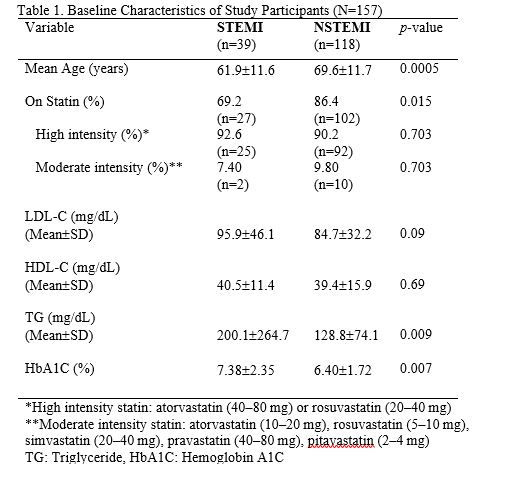
Results: A total of 173 subjects participated in the study. Sixteen patients were not identified as AMI. A total of 157 patients were determined to be AMI, of whom 39 patients (24.8%) were STEMI. Compared to patients with NSTEMI, those with STEMI were 8 years younger (mean age: 61 years), taking less statins (69%), and had higher TG (200mg/dL) and mean HbA1C was 7.4% (Table 1). Despite background of statin therapy and guideline directed compelling medications, LDL-C was not a significant predictor of STEMI in a multivariate logistic analysis. High TG alone (OR=3.38, p=0.03) or TG-HbA1C ratio was a statistically significant predictor of STEMI controlling for age, sex, BMI and other lipid profiles, demonstrating that patients with TG >=140 mg/dL were 3.4 times more likely to have STEMI or TG-HbA1C ratio >18 was 6.3 times more likely to have STEMI (OR=6.26; p=0.008) (Table 2).
Conclusions: Despite gold standard statin therapy and guideline directed compelling medications, conventionally utilized LDL-C was no longer an optimal marker predicting coronary artery disease in a real-world setting. TG-HbA1C ratio was a better indicator predicting STEMI to be utilized in a clinical practice.
Reference:
- Gandhi, S., Garratt, K. N., Li, S. et al, Ten-Year Trends in Patient Characteristics, Treatments, and Outcomes in Myocardial Infarction From National Cardiovascular Data Registry Chest Pain–MI Registry. Circ Cardiovasc Qual Outcomes. 2022;15:e008112. DOI: 10.1161/CIRCOUTCOMES.121.008112
-
Scudeler, T. L., Alves da Costa, L. M., Belo Nunes, R. A., et al., Association between low-density lipoprotein cholesterol levels and all-cause mortality in patients with coronary artery disease: a real-world analysis using data from an international network. Scientific Reports. 2024; volume 14, Article number: 29201
Biography:
Dr. Wani is an interventional cardiologist specializing Interventional Cardiology, hyperlipidemia, heart attack (STEMI) and cardiovascular disease research. He holds an MD from Government Medical College, Kashmir University, India and completed residency at USC/LA General and fellowship at USC. He is currently a director of cardiology department at Northern Arizona Healthcare.
Copyright 2024 Mathews International LLC All Rights Reserved
